Monday, 24 April 2017

MEST 2 - Evaluation

MEST2: Evaluation
The brief, which I have been assigned to work under, requires an arthouse film to be made for a company named “Little Picturehouse”. The film produced by my group is called “Click”.  Interestingly, the movie contains film-noir and urban elements which is our unique selling point as it is attractive to our target audience; this recounts back to the brief and its specifications.
The pre-production of “Click” has contributed massively towards the creation of the film. Films that have similar styles as “Click” has had a major influence with the overall making of the film as it provided a foundation to work from.  “Sin City” has similar elements, which fascinated our group especially in the way it was processed. It contains styles that were appealing i.e. the use of detectives and the villains. Another film that has the same aspects as “Click” is “Scarface”. The use of mafia bosses in the film has been iconic in film history with many films being influenced by this particular movie. Similarly, my group has used these characteristics of the film and added these elements onto “Click”. This allowed our creative approach to flow as it permitted different angles to be executed to present a perfect representation of “Click”. The BBFC research had an impact as it has informed my group about the basic guidelines needed for a 15-rated film. For example, strong violence, frequent strong language etc.  The amount of strong language was vital to be controlled as multiple explicit words can make the audience uncomfortable.

Due to the fact that there is a shortage of younger viewers watching arthouse movies, it has provided a purpose for “Click” to appeal to audiences that usually are not associated with arthouse movies. “Click” has a demographic of ABC1 as people who often go to the cinema can relate to the experience of watching a movie in an arthouse cinema. The audience may have to be employed or have parents that are working as typically an arthouse film is watched by middle class or people that have experience in the media industry. Young and Rubicam invented a successful psychographic profile as they suggested people would fit into one of seven groups. The target audience for Click would fit under mainstream as the action and drama can be relatable for most audiences. Suits would be a common purchase as there are many present inside the film.  As younger people are not usually associated with arthouse cinemas, it would be difficult for the audience to have a wider range of an audience. As this is an arthouse movie, there will likely be a secondary audience of 38-55 year olds. We believe there will be a 70/30 split of males to females as the storyline and actors are predominately male and there isn’t currently a plan to include a romance in the clip. This, perhaps, is the main weakness of the target audience as it causes a divide in the overall reception of the film. However, I believe that our group has succeeded in attracting a younger audience to arthouse cinemas as it incorporated elements of cinematic action that is usually seen in multiplex cinemas.

Click is shot in different locations as it represents the different societies and age groups that the target audience covers. One area that was shot was in Canary Wharf; this scene was to show the sophisticated side of Click. The rest of the scenes were in local areas as the younger audiences can gain personal identification with the film. The overall production has a slow structured establishing shot to reveal how one of the protagonists acquired his superpowers. Though, we chose to contrast this immediately with a torture scene, I believe that it allows the interesting camerawork and editing to be admired. The different shots were used to give the audience the impression of acting and allowed for total diversion from reality. By subverting some stereotypes it allows the applying of contrapuntal sounds in scenes which portrays violence, it lets the audience become fully focused on the film. This allows the main objective, which is to make sure that the arthouse theme is met, be completed successfully. Barthes’ enigma and action codes were also employed to allow the viewer to have a better understanding when a character is introduced. The strengths of the torture scene is the unique style of the editing however the lighting in this clip could have been improved as it would reduce the amount of grain which is visibly shown. Additionally, another key scene in the extract was the discovery of ‘Spiker’s’ body. The stimulating use of cinematography in this scene helps increase tension. This assists the bewildered audience with the raised tension further enhances the approval of the film; the film follows the arthouse theme throughout. The major scene in Click is when the fight scene starts. There is the classic convention of a shootout between the protagonists and antagonist. By using jump cuts, it builds tension and using shot/reverse shots allows different angles of the fight scene to be shown. Interestingly, the final part of the scene uses point of view shots. This allows Blumler and Katz’s Uses and Gratifications theory to be applied in Click. There is a clear sense of personal identification and diversion to occur for the audience. Also, by introducing the Good vs. Evil concept, our group created some binary opposition (Levi-Strauss). This also provides a voyeuristic pleasure for the viewer as the audience feel like they are emotionally involved. An improvement that could have been introduced is the lighting as the scene became distinctively darker. This allowed certain shots to contain noise which depreciates the viewing experience.

The print work matches the key conventions of an arthouse cinema brochure or an arts centre as it helps inform the target audience about the films being released. This information is important as there are sections in which helps understand what films like Click are made and whether there are exclusive features. Not only this but it also has aspects of the personal identity appeal, in that readers may be able to feel that certain situations apply to them for example the process of making a film. On my front cover, there is a solid magazine publication title with the date. To gain the attraction of the reader, the central image is positioned in agreement with the rule of thirds. To have a specific colour scheme is important as it enhances the professional outlook of the print work.  The Little Picturehouse branding is visibly noticeable with social media links at the top. Print work containing large text is difficult to read which inevitably puts off audiences. On the contents page, I worked a straightforward design to list the films and exclusive features in the magazine however inserted an imaginative outlook by introducing a montage of pictures from the represented films. I also included quotations from famous directors to influence and attract audiences to enjoy the film industry. I believe that there is synergy with the other pieces of print with the branding as I feel that I followed the conventions of an arthouse brochure. However there are element in which it can be improved. For example, the double page spread could have been edited in a more sophisticated

In Click, we attempted to embody a wide set of societies and cultures. In order to stand out, the group decided to subvert Hollywood stereotypes. The use of two main protagonists, who are culturally diverse, is important as it subverts the stereotypes in films. Culturally, families from around the world should be able to represented well enough; actors in films are generally from America. Due to the fact that typically Hollywood’s leads are usually white, it subverts the main ideologies in the film industry. It provides a different angle as the audience can identify with the characters. Therefore, we can use Perkins’ theory to show that certain stereotypes are not permanently negative. However, we can likewise operate Medhurst’s shorthand value judgement with the main antagonist due to the fact that he is of an ethnic minority. Additionally, my group decided to use a set of teenagers as the main cast. This is important as usually adults generally gain the leading role. By using teenagers, the younger audience gain a sense of personal identification. On the whole, I deem that the representations, we have shaped in this extract, we have undermined the conventional standards in cinema and this corresponds well with the arthouse genre as a whole.

Promoting films online has been a major tool to reach out to a larger audience as the reception that websites like YouTube are receiving is massive. This becomes evident especially major industries are releasing trailers online. I believe the online film blog can support the promotion of our arthouse film as audiences are the world can access and assess whether they would find the film interesting. To use the internet is important as it can give a psychological advantage in succeeding in reaching your target audience. In order to reach out to the target audience, the content available in the online blog should be attractive to our audience. Audiences want to feel a sense of personal satisfaction and the inclusion of bloopers can attract audiences. Social media has become a great force in marketing as people are able to voice out their own opinions regarding the specific film. This can provide a sense of comfort for other people as they could consider whether watching a certain film in advised by viewers that watched before. Evidently, there are a larger audience in social media as people can be able to stay connected and voice their own opinions. The creative response is important as it is able to be evaluated in different angles and fully assessed.  There are elements of user-generated content that can be incorporated, for example parodies and the audience creating their own trailers. Films like Ill Manors use a unique campaign to promote their movie to a city-wide scale. The campaign has provoked a response as people used this hashtag as a chance to voice their opinions. The fact that it was being screened at major landmarks suggests that people that were generally not associated with the genre and the class are being notified about the hidden truths. This technique is a unique way to promote the movie. This provided a clear example that can be used for our own film.

I believe that Click has succeeded in meeting the original brief as it has incorporated many elements that attract a larger field of audiences. The inclusion of drama, crime and action as well as providing a sophisticated outlook has caused a successful integration of cultures. This, in fact, is the principal reason in why Click can become successful in the marketplace as the younger audience can fell included in the voyeuristic pleasures.


Wednesday, 1 February 2017

Photoshop Tutorials - Production progress report - Selected Photos

Photoshop Tutorials


Production Progress Report 

Click:

Parts we have completed:
  • Filmed 3 of the 4 scenes
  • Nearly completed the filming

  • WWW: We were very organised which is important in terms of the progression of the film being completed
  • WWW: The props were used effectively in the film
  • EBI: The decisions of some scenes are questionable e.g. the location inside Bond Street
  • EBI: The camerawork needs improving

Photos Chosen: 


Sunday, 22 January 2017

Print Brief


The BFI Film Festival follows most of conventions of magazine covers. The use of the title of publication, which is placed near the centre of the cover, is very important as it is easily visible, particularly when stacked with other magazines in limited shelf space. The way the title has a different font and colour makes the magazine easily visible and distinctive. Additionally, the typical typeface becomes established which means that the magazine’s logo can be edited in the way the editor views the title. Due to the title being well known, it can be modified and can be understood easily .There isn't any use of a slogan. This is perhaps due to the fact that it has different editions with a serious outlook. The use of slogan may not be in the desires of BFI. The peculiar use of the central image being the text for the title. This is to enhance the attention and captivate the viewers attention and also bringing more attentions towards their brands. The use of  a ‘Flash’ or a 'Cover Line' is not visible as I believe the main reason why there is not this convention is there is not a necessity to employ this technique. This goes with the free offer as well as it is not necessary for an art house magazine. Also, mainstream magazines sometimes come with small gifts or product ‘promotions’ attached to attract more viewers. The BFI magazine  To be effective, these gifts or offers need to be closely targeted at the magazine’s core consumers.Another convention that is regarded as important is the colour scheme. In order to avoid a cover becoming too ‘overcrowded’ with colour and therefore difficult to ‘decode’, designers tend to stick to a limited colour scheme. However there is still a use of extravagance with the title to make the title stand out for the readers. The colours are generally limited but it feels that it works well together and provides a particular ‘attraction’ towards the magazine.


Brochures Research
The most appealing aspect that I believe that stands out for me is the colour scheme. Although the colours are bland and not vibrant, it follows a simple scheme which shows off its professionalism. This is important especially with my proposed print work as it should have a connection with art house conventions. Therefore, having a structured colour scheme is important with the attraction of brochures.
I believe the most engaging aspect about this brochures is that the size of the fonts stands out for me. It provides a sense of professional expertise which is important with a brochure. This is significant especially with my proposed print work as it follows with art house conventions. The font should be necessary with the overall meaning of the brochure. It should follow the appeal of the reader and what the editor wants to stand out. Therefore, having a structured use of fonts is consequential with the attraction of readers.
I believe the most attracting feature about this brochures is that the placements of images and text which stands out for me. This might influence me to use images inside the designated areas rather than keeping it plain or with a structured images policy. Also, the thing that I could use is the consistent use of graphical shapes and designs. It should follow the appeal of the reader as they are reading the brochure and also how the editor wants to stand out. Consequently, having a attractive layout is important with the diversion of readers from reality.


I like the interesting use of the layout and the placements of images. This can influence the reader as they can see the professionalism of the brochure. Also, the thing that I could use is the consistent use of graphical shapes and designs. This is important especially with my proposed print work as it should have a connection with art house conventions.


The most appealing aspect that I believe that stands out for me is the colour scheme. The colours are vibrant which is important with the attraction of readers. It also follows a simple scheme which shows off its professionalism. This is important especially with my proposed print work as it should have a connection with art house conventions. 


Contents Research

This contents page uses an interesting use of contents page and the way it is placed; the pages being symbolic of the mph readings in a car. It is displayed in a unique way which is important especially when a company
One thing that I will definitely take into consideration is the use of the 3 step rule. This contents page delivers a great example of both what I want to create (in terms of structure), as well as aesthetics. This cover page really delivers on the portrayal and use of the three step rule (the division of the page into three). This contents page can help me identify how to structure the contents page such as, where to place the pictures/images or text.
 Although we are required to use images in our contents pages, what this shows is that the lack of colour can also be used to provide a professional outlook; almost as if they are codes in relation to different sections there are in the magazine. It brings out a professional look which is important.


This contents page has a interesting layout which I find appealing; the images and text are displayed in a alluring manner. This provides an experienced outlook which is important especially towards the editor.

This film brochure has a running theme present on the pages. I like the way that the theme of wheels and colour patterns are consistent to the cover page. Moreover, the use of having the writing structured in the way it is conveyed in the image above is a very nice representation of the way I may like to use for my own programme.


Planning and sketching

Create a spider diagram or bullet point list of all the things your target audience might be interested in.


2) Produce an A5 sketch of your front cover including the key conventions and design tricks you have studied in existing programmes and then planned in planning task 1 above.

3) Produce an A4 sketch of your double-page spread contents page. In terms of the text for your contents page, you will need to find out the names of the films of other groups in your class. The other films in the class will make up the rest of your contents page.

4) Create a spider diagram or bullet point list of ideas for your double-page spread feature. Write a list of potential headlines and sub-headings for the article you choose to go with.


5) Produce an A4 landscape sketch of your double page spread design now you have chosen the subject matter.


Photoshoot

1) Which of your main characters will appear on the front cover of your programme?
Hitik (Forbes), Abdullah (Banks), Hussein (Brute)

2) What image or images do you need for the contents page?
We will need images of a gun, the three actors and a location such as the office.

3) What image or images will you use for the double-page spread?
Our group will mainly use the image of the three actors as they are the most prominent characters in the movie. We will all be in the costume we are wearing for the actual shoot, Hussein and I will be in suits and Abdullah will be in a dressed down blazer.

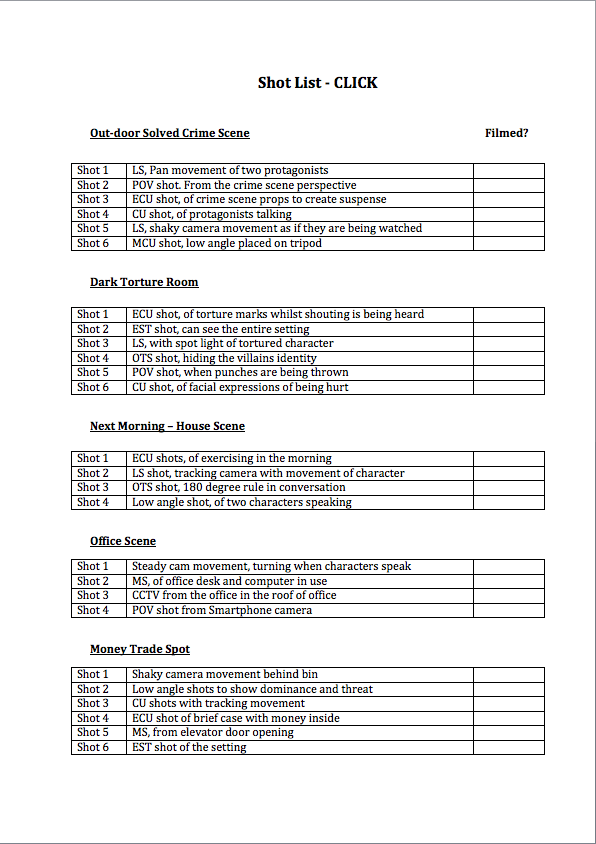
4) Write a shot list for the photoshoot. Make sure you plan a variety of camera shots you will look to capture - medium shots, close-ups etc.
Brute
All Characters
Forbes and Banks
Medium close up - focus on facial expression
Medium Shot – Brute positioned in front of the characters
Medium Shot –both positioned beside each other
Medium Close up - holding a gun
Medium Shot – Brute positioned behind the characters
Medium Shot - Focus on the attire of the criminal
5) What costume, props or make-up will you require for the photoshoot?
  Fake Blood, Suits, Fake Guns

Wednesday, 4 January 2017

Mise-en-scene - Click

Mise-en-scene – Click
Scenes
Actual Locations
When the scene is applicable


Canary Wharf Station
When both detectives are discussing the potential crime scene

Characters
involved 

  • Zayn Banks
  • Joe Forbes


LOMBARDY RETAIL PARK, SAINSBURYS CAR PARK, HAYES
When the fight scene occurs

Characters
involved 
  • Zayn Banks
  • Joe Forbes
  • Brute
 

Office, Greenford High School
When Jean returns to the office to reveal traumatic news to Joe.

Characters
involved 


  • Zayn Banks
  • Joe Forbes


Person’s House, Northolt.
Establishing shot of Zayn’s house

Characters
involved 


  • Zayn Banks
  • Joe Forbes

Props that is needed:
·         Fake Blood
·         Suits
·         Fake Guns
·         LED Lights
·         Police Tape
·         Cards with numbers
·         Metal Suitcases
·         Tripods
·         Steadicam
·         Lavlier microphones

Costumes
·         Suits
·         Domestic clothing
·         Balaclava


Casting Details
Abdullah Al-Fadhli – Detective Jean-Baptiste Banks - a detective that has had a fatal experience of watching his family being tortured by the kingpin ‘Brute’ in front of his eyes. Jean desires vengeance but has been frightened of ‘Brute’ ever since.

Hitik Gohil – Detective Joseph Forbes – a detective who hasn’t experienced the same ordeals as Jean but feels sympathetic. Just as Jean, he feels that Brute has to be taken down. Joe and Jean are partners at EPD (Ealing Police Department).

Hussein Hamume – DeAndre Jones (Brute) – nicknamed Brute due to his aggressive manner towards his enemies. Due to his harsh childhood, Brute has chosen the path of crime. He is the kingpin of the Ealing area with many well-known criminals and policemen (not Detective Jean and Joe) work for him.

Hussein Abd – Mustapha ‘Spiker’ Ali – (Former drug dealer to being a reformed character). He now works in a grocery store. Spiker had to change his ways due to the fact that he is experiencing loneliness because he misses his daughter ‘Alia’. However he has been persuaded to one last job for a rival gang which was to kill ‘Brute’. This is important as Spiker didn’t originally want to do this act but was blackmailed due to the threat that the gang mad towards Alia.


Project Schedule


AS Coursework - Script

CLICK
15TH DECEMBER 2016

WRITTEN BY
HITIK GOHIL


SCENE 1 – SPIKER’S DEATH

THE SUN IS SETTING, A DEAD BODY IS SURROUNDED BY POLICE CONES AND SIRENS ARE HEARD IN THE BACKGROUND

FORBES:
This is a case that should be left alone.
BANKS:
You know we can’t do that, we’re paid to solve this shit.
FORBES:
You know what this means right?
BANKS:
Yeah, damn.

FORBES IS SEEN WALKING AWAY, BANKS FOLLOWS HIM

BANKS:
He’s back in town, we need to find him.
FORBES:
Why?
BANKS:
Because I said so, anymore questions?
FORBES:
Someone’s on his period.


FORBES WALKS INTO THE DISTANCE, THE SCENE FADES TO BLACK.


SCENE 2 – BRUTE’S EMERGENCE

BRUTE IS SEEN SPEAKING TO HIS GOONS IN THE BACKGROUND, A MAN IS TIED TO A CHAIR

BRUTE:
So you’re the little shit that tried to jump me?
SPIKER:
No.
BRUTE:
Where's my goddamn money?
SPIKER:
I don't have your money.
BRUTE:
Wrong answer.

PUNCHES ARE HEARD WHILE BLOOD SPLATTERS ONTO THE GROUND


SPIKER:

Alright! It's at...

BRUTE WALKS TOWARDS THE CAMERA AND IT ZOOMS INTO HIS EYES, IT SEGUES INTO THE DETECTIVE’S OFFICE.


SCENE 3 - LATE

FORBES IS SEEN STANDING OUTSIDE A HOUSE AND WAITING FOR FORBES

FORBES:
Hurry up man, we're late.
BANKS:
Yeah, give me a sec.


THEY ARE THEN SEEN IN THE OFFICE WAITING AT THEIR DESKS. THEY RECEIVE A NOTIFICATION ASKING THEM TO RESPOND TO AN ONGOING MATTER.


SCENE 4 – REALITY

BRUTE IS STANDING IN AN ABANDONED AREA WITH A BRIEFCASE, HE SENDS A TEXT TO BANKS WITH HIS LOCATION, WE SEE THE SUN DIPS AND BANKS APPEARS

BRUTE:
Are you just going to stand there?
FORBES:
(Into communication device)
He's here.
BANKS:
(Into communication device)
Okay, I'm coming.

FORBES IS SEEN WALKING TO BRUTE, HIS BODYGUARDS COME TOWARDS FORBES AND RAISES THE GUN. 

BANKS:
(Stops time)

BANKS DISARMS THE BODYGUARDS AND COLLAPSES THE BODYGUARDS. FORBES GOES TO A SAFE LOCATION.


BRUTE:
What’s this voodoo shit you’re doing, where’s my gun?
BANKS:
You used to be the kingpin, looks like there’s a new boss in town.

BRUTE LUNGES TOWARD BANKS AND PUNCHES HIM IN THE FACE, HE CONTINUES TO JAB AT BANKS, HE CLICKS HIS FINGERS AND THE SCENE STOPS.

BRUTE:
The hell is going on?
FORBES:
Alright, watch out this time, he’s going to try and grab you.
BANKS:
No shit, Sherlock.
FORBES:
Take him out at the knees, then hit him in the centre of the chest.
BANKS:
Will that kill him?
FORBES:
No, he’ll just be unconscious.
BRUTE:
Consulting the only one with a brain at your firm?
BANKS:
(Laughs at BRUTE)
BRUTE:
You only have the body bro, can’t do anything without the smarts.
BANKS:
(Looks at BRUTE)
 FORBES:
Don’t listen to him, knock him out.
BRUTE:
He’s going to realise that you’re dead weight soon, he’ll ditch your ass.
BANKS:
He has one thing you don’t: loyalty.

BANKS CONTINUES TO BEAT BRUTE AND HE EVENTUALLY HITS BANKS

FORBES:
Are you not going to hit his neck?
BANKS:
Nah screw that shit, this guy is about to get murdered.

AN EPIC BRAWL ENSUES, BRUTE GETS SOME JABS AT BANKS AND BANKS CLICKS AND STOPS TIME. HE HAS ONE FINAL HIT ON BRUTE AND BRUTE FALLS TO THE GROUND

BANKS:
It’s over now.
BRUTE:
You don’t have the balls to kill me.
BANKS:
(Raises gun)
Try me.

A GUNSHOT IS HEARD AND BRUTE FALLS TO THE GROUND, FORBES APPEARS AND PATS BANKS ON THE BACK

FORBES:
It’s done now, the threat’s gone.
BANKS:
It’s funny how we spend our lives looking for murderers and today, I’m that person.
FORBES:
Cocky shit got what he deserved.
BANKS:
Yeah he did, listen, thanks for your help man I-

FORBES:
Don’t sweat it.
BANKS:
Thanks man.

THEY ARE SEEN WALKING AWAY FROM THE AREA AND INDISTINCT CONVERSATION IS HEARD.

BANKS:
Well, I guess I’ll see you at work tomorrow
FORBES:
Yeah, business as usual.

THEY SHAKE HANDS AND GO SEPARATE WAYS, THE CAMERA GOES BACK TO BRUTE. WE SEE THAT A CHEMICAL HAS SPILT INTO HIS MOUTH AND HIS EYELIDS OPEN SLOWLY. A PULSE IS EMANATING FROM HIS SKIN, HE HAS ACQUIRED SPECIAL POWERS. HE IS UP ALMOST INSTANTANEOUSLY.
BRUTE HAS NOW ACQUIRED POWERS SIMILAR TO BANKS.

BRUTE:
Oh it’s on now.


END

Thursday, 15 December 2016

AS Preliminary task - Script

SCREENPLAY FOR PRELIMINARY PRODUCTION 

“THE WRONG GUY” 

BY ABDULLAH ALFADHLI & HUSSEIN HAMUME


OUTSIDE CINEMA
PROTAGONIST SITTING OUTSIDE ART HOUSE CINEMA ON THE PHONE WAITING FOR THE FILM. 
ANONYMOUS PERSON MARCHES TOWARDS HIM TO WARN HIM ABOUT OWED MONEY FOR HIS BOSS. 
CONFUSED PROTAGONIST ACTS DEFENCIVELY AND GETS ANGRY WITH THE MESSENGER. 
MESSENGER: 
‘SO HAVE YOU GOT THE MONEY?’ 
PROTAGONIST: 
WHAT MONEY? WHO ARE YOU?‘ 
MESSENGER: 
MY FRIENDS MONEY… BAD THINGS WILL HAPPEN IF YOU DON’T PAY HIM BACK’ 
PROTAGONIST: 
WHO ARE YOU MAN? GO AWAY GET OUT OF MY FACE’

MESSENGER LEAVES THE SCENE AND PROTAGONIST ENTERES THE CINEMA TO WATCH THE FILM.
PROTAGONIST WALKS THROUGH CORRIDOR AND RECIVES A PHONE CALL FROM A FRIEND, THE GOES AND TAKES A SEAT.

SUDDENLY SOMEONE FROM BEHIND THE PROTAGONIST HEAD LOCKS HIM AND KIDNAPS HIM TO AN ABANDONED PLACE WHERE HIM AND HIS BOSS INTERGATE THE PROTAGONIST.

PROTAGONIST: 
HE IS GRABBED BY THE GANG BOSS AND THE BODYGUARD AND PRESSED AGAINT THE WALL.

‘WHO ARE YOU? WHAT AM I DOING HERE?’ 
FRIGHTENED. 
BOSS: 
PRESS HIM ON THE WALL. ARE YOU LUKE?‘  
ASKING THE PROTAGONIST.

PROTAGONIST: 
WHO’S LUKE?’ 

BOSS: 
ANSWER MY QUESTION, ARE YOU LUKE OR NOT?

PROTAGONIST: 
WELL IF YOU’RE NOT LUKE WE KNOW WHAT TO DO…’  
BODYGUARD: 
REPLIES: ‘Yeah…’  

THEY KILL THE PROTAGONIST ON SITE.


THE END.

Audience research focus groups: blog write-up

My production team: Hussein, Hitik & Abdullah

The focus group has helped the team get a greater understanding of what is needed for the film to be an exceptional arthouse movie. Quite evidently, the focus group listened to our with the perception that the overview about the theory of arthuse movies was not being met. The storyline contained a modern-noir detective feel in which there is a typical storyline of good vs evil; the storyline consists of two detectives; one who is intellectually smart and one who is blessed with supernatural powers.

The summary of the key points that was given to improve our film-idea concept:


  • Play with the narrative structure to entice the audience's minds with enigma codes.
  • A non-linear narrative will make more intellectual demands on the audience which enhances attenction and creates diversion.
  • Binary opposition between the two narrative forces to demonstrate clear opposition and to help u the audience to understand who are the antagonists and the protagonists.
  • Look at Sin City, it has an arthouse element.
  • Don’t use too many Hollywood key elements as it would lose the uniqueness of the movie.
  • Research the special effects as it will be an important element to the success of the movie and the professionalism of the quality.
  • Forget about the franchise because arthouse as a genre is mostly one offs.
  • He finds out he has a superpower last and the fight seen happens first.
  • Reset time so you know what happens.
  • Time is the centre of the whole thing, the narrative will revolve around time.


  • I believe having discussions would allow a significant improvement in terms of the quality. The discussions that are brought forward will allow information like this to be very useful, as they will bring forward issues and new ideas that were no thought of before. My team initally presented the idea to our classmates, believing honestly that our idea would not require improvements. However we were proved wrong. Firstly, our team explained our concept and the general narrative. linking the subject theme, which is arthouse, and also adding a supernatural effect to the production idea.

    There were many elements that were brought up in the discussion that helped the overall understanding of the creation of the movie. One element of the idea that was that one of the characters contains powers that could play around with time and one suggestion was to make the concept of time as the main proposal from the extract. The way our group explained the powers of time is that it would only be used in conflict with the antagonists especially in fight scenes which contained the most danger. What’s also strange is that only one of the protagonists has a supernatural power and his partner is the intelligent role of the two. This gives an opportunity for different audiences of different personalities to relate to either on of the heroes due to the opposite personalities. The role for the superpower character is seen as dominant and powerful in the narrative on the other hand the other role for the detective is seen as wise and as a leader. 

    Another key concept is by playing with the narrative structure of the film to reinforce the key concept of time and break the convention rules for continuity; this will be constructed in the postproduction aspect of the project. The ability to break the common conventions is the beauty of the Art house genre, the extract will start will start with the disequilibrium from Todorv’s theory to grab the viewers attention. The overall result of the focus group I believe was very positive as it refined the overall concept as well as brought forward problems taht needs correcting.

    Target Audience

    The target audience that my group is aiming at is going to be targeting the 15-26 age bracket. In the brief, it states that this film should appeal to the younger audience in terms of young adults. Also, this film will be certified at a 15 rating due to our group trying to reach the largest audience possible. As this is an arthouse movie, there will likely be a secondary audience of 38-55 year olds. We believe there will be a 70/30 split of males to females as the storyline and actors are predominately male and there isn’t currently a plan to include a romance in the clip. We will be targeting the ABC1 class bracket as it is all encompassing however, as it is an arthouse piece, we will likely be getting viewers that typically are in the higher class brackets. They will likely have university degrees and will likely have a job in Central London where they are earning a good salary. 

    Monday, 12 December 2016

    Arthouse Film Research

    Production: Independent film studios

    Eternal  Sunshine of the Spotless Mind - Focus Features
    Other Films that Focus Features produced:
    • Fifty Shades of Grey
    • Brokeback Mountain
    • Lust, Caution
    • 9
    • Milk
    Focus Features success 
    Focus' most successful release in North America to date is Brokeback Mountain (2005), which earned $83 million at the North American box office. However, this is not counting the domestic total of Traffic (2000), which earned $124.1 million under the USA Films banner. Focus' most successful international release is Burn After Reading (2008), which earned $163.7 million in worldwide gross revenue.


    It Follows - Northern Lights Films
    Other Films that Northern Lights Films produced:
    • The Brass Teapot  
    • High Road 
    • I'll See You in My Dreams 
    Northern Lights Films success 
    Northern Lights films was the 5th highest US Gross Box office of independent film companies in 2015 and making waves in the world wide box office as well.  The projects have won many awards working on  different films and different genres of films. 


    United 93 - Universal Pictures, Studio Canal 
    Other Films that Universal Pictures produced:
    • Jason Bourne
    • The Secret Life of Pets
    • King Kong
    • Nanny Mcphee and the Big Bang
    • Fast and Furious
    Universal Pictures success 
    Highest-grossing films worldwide
    RankTitleYearBox office gross
    1Jurassic World2015$1,670,400,637
    2Furious 72015$1,516,045,911
    3Minions2015$1,159,398,397
    4Jurassic Park 
    1993$1,029,153,882
    5Despicable Me 22013$970,761,885
    6E.T. the Extra-Terrestrial 
    1982$792,910,554
    7Fast & Furious 62013$788,679,850
    8The Secret Life of Pets2016$676,658,314
    9Fast Five2011$626,137,675
    10The Lost World: Jurassic Park1997$618,638,999
    11Mamma Mia!2008$609,841,637
    12Fifty Shades of Grey2015$571,006,128
    13King Kong2005$550,517,357
    14Ted2012$549,368,315
    15Despicable Me2010$543,113,985
    16Meet the Fockers2004$516,642,939
    17Twister1996$494,471,524
    18Bruce Almighty2003$484,592,874
    19Jaws1975$470,653,000
    20Lucy2014$463,360,063
    21Gladiator2000$457,640,427
    22The Bourne Ultimatum2007$442,824,138
    23Les Miserables2012$441,809,770
    24The Mummy Returns2001$433,013,274
    25Warcraft2016$422,262,155

    Other Films that Studio Canal produced:
    • Paddington
    • The Terminator
    • Non-stop
    • My King
    • The House of Magic
    Studio Canal success
    The biggest box office hits for StudioCanal have been Terminator 2: Judgment Day which grossed $519 million, Basic Instinct which grossed $352 million and The Tourist which grossed$278 million worldwide.


    Buried - The Safran Company
    Other Films that The Safran Company produced:
    • The Conjuring
    • Annabelle
    • Hours
    • ATM
    • Best Night Ever
    The Safran Company success
    The film company has also produced Paul Walker's movie after his death, Hours. The Safran Company also created both The Conjuring and The Conjuring 2 which collectively grossed over $600 million.

    La HaineCanal+, Egg Pictures 
    Other Films that Canal+ produced:
    • Blue is the warmest color
    • Shut In
    • The Intouchables
    • Amelie
    • The Pianist
    Canal+ success

    Other Films that Egg Pictures produced:
    • The Baby Dance 
    • Home for the Holidays 
    • The Dangerous Lives of Altar Boys 
    • Waking the Dead


    Distribution: Independent film distributors

    1) Research film distribution using this guide from the UK Film Distributors' Association. It's called Launching Film and takes you through the whole process of distributing a movie.

    Read the whole step-by-step guide (warning: this is LONG and will take you around an hour)
    2) Summarise the 10 steps of film distribution in a list using your own words.

    • Step 1 - Introduction: Films are made to inspire, to convey strong emotions and to express what people want to say and the best way to view them is in a cinema with a large audience.
    • Step 2 - The role of the distrubuitors: Distributors job is to deliver the largest audience possible for a film. Tailor-made, audience focused distribution focuses on all aspects of a particular film and tries to reach people that are appropriate for the film. Also the end of 35mm film has changed the way in audiences are found because digital film making is different in style. Audiences still choose to go to a cinema to watch a film because of the immersive experience.
    • Step 3 - The role of the Distributor In order to reach the right audiences, distributors have to identify the films, consider why people will see a particular film, estimate the revenue, persuade theatres to screen the film and also work with advertisers to reach mass audiences.
    • Step 4 - Who are the distributors?: There are 6 major film distributors for Holywood films and several independent ones which focus on Art-house films. 
    • Step 6 - Distributors getting the film: Distributors get their films from : 3rd party companies, parent studios, production companies or from a single title acquired at any stage. Many times the rights to film distribution will sold off to the actual distributor so they can generate thier own income rather than relying on the studio to fund them. An example of this Harry Potter which its rights belong to Warner Bros Distribution and they're responsible for the marketing and products of the film. An independent distributor will market the film on a lower scale such as film festivals and online. 
    • Step 6 - Making a deal: Distributors sign a formal contract with the producer, sales agent or studio, specifying the rights they hold to the title and also they regions they can distribute in.
    • Step 7 - Planning the release: Once both parties reach an agreement and sign all the necessary contracts the distributors will work closely with the production team to make sure they reach the right marketing strategies. They prepare all the plans needed while working with the script of the film and applying their work to the genre and storyline of the film.
    • Step 8 :  The distributor will do research about how relate-able the genre is to audiences and will ask questions like 'Who is this film for?' In addition this they will find out how much profit they film is likely to earn because of course their goal is to make a profit.
    • Step 9 -Film Marketing: "Marketing needs to lead a horse to water and also persuade it to drink." - Marketing can be done online, on publication or digitally/ socially, eg: Facebook, Twitter and YouTube. Marketing is always about visibility and about getting the best billboard placement and the amount of views a trailer gets.
    • Step 10 - Licensing: This basically legally covers the film in terms of where it can be shown. Examples of exhibitors are: Vue, Odeon, Cineworld, Independent Cinemas, Film4, BBC Films, Netflix, Hulu, YouTube and just generally TV or streaming services.
    Research Curzon Artificial Eye. Who are they and what do they do?
    They are a British film distributor who are associated with the Curzon industry. They screen foreign film with non-english languages and screen them in arthouse cinemas all scattered around the city of London.

    Look at the Curzon Artficial Eye YouTube channel. Watch three trailers for recent or upcoming independent films and identify something you can learn from each film to use in your own film production.
    Almost Holy: it could inspire to have a normal character talking over a series of different clips parallel to the speech, almost giving the effect of being a narrator. In addition of adding non-diegetic dramatic soundtrack to create tension.

    Christine: keep the pace of the clip quick and fast to create tension and suspense and obstruct the shot to create tension.

    The Commune: it could help me learn how to create tension and build suspense without too many cuts in post production. It could help inspire some performances as well as acting techniques. 


    Exhibition: Arthouse cinemas

    The name of the chosen arthouse cinema is called the Everyman Cinema, its a London based cinema in Canary Wharf.

    Everyman Cinema screens many independent film that are not really targeted or appreciated with mainstream audiences, however it does not mean that all of the movies shown in this cinema are not screened in multiplex cinemas such as Vue. One film that is screening this week is 'Allied' which is also screening at Vue all over the country. A vast majority of the films they host are rated 15 and above by the BBFC, this is because the arthouse cinemas appealing to a mature audience and are usually appealing to the older generation.

    An older film consumer would attend this cinema due to the fact it hosts many films that are rated 15 and above. In addition people of the middle class and upper class would go to this location rather than a mainstream cinema because it is very luxurious and expensive compared to the conventional everyday cinema.

    A case study in independent film production: Film London and Microwave Film

    Film London: Film London is London's film and media agency - sustaining, promoting and developing London as a major international film-making and film cultural capital. Film London aims to ensure London has a thriving film sector that enriches the capital’s businesses and its people.

    Film London’s objectives are to:

    • Grow the film industry in London
    • Maximise investment in London through film
    • Sustain London’s film culture
    • Promote London to the world through film


    Microwave Film: Microwave funds films, they give development and mentoring support to all of the shortlisted projects, as well as production finance and distribution support to the final commissioned films. Twelve teams are shortlisted for the scheme, and receive concentrated training at Film London Microschool along with mentorship and development funding. From this shortlist, six projects are selected to go on to a second phase of development with further funding. Lastly, two features are appointed and receive additional development, in addition to production funding of £100,000 and distribution funding for finished films.

    London Calling: London Calling is open to all new and emerging film-making teams resident in the capital. Run across nine months, highlights of the scheme include: 15 short films are awarded a maximum of £4,000, training and mentoring is provided to all film-making teams, match funding can be sought for any film being produced through London Calling. 

    4) Choose three feature films funded by Microwave Film and embed their trailers in your blog. For each film, explain why it fits the profile for an arthouse or independent film and what target audience the film might attract.
    5) Watch these top tips for film production. List three things you've learned from these short videos that you can apply to your MEST2 production work.